

A Mom’s Guide to the 4 Types—and the One That Works Best
Have you ever caught yourself wondering, “Am I being too soft?” or “Was I too harsh just now?” If you’re a mom (or any parent!), these questions probably pop up more than you’d like. The truth is—we all parent differently, and that’s okay. But psychology offers a useful framework to help us understand how we parent and why it matters.
Let’s take a deep breath, pour a warm cup of tea, and explore the 4 main parenting styles, how they affect your child’s development, and which one psychologists recommend for raising confident, emotionally healthy kids.
 What Are Parenting Styles?
 What Are Parenting Styles?
In the 1960s, psychologist Diana Baumrind introduced the idea that the way we parent tends to fall into patterns. Later, researchers expanded her work into what we now call the 4 parenting styles. These are based on two core dimensions:
- Responsiveness: How loving, warm, and emotionally available a parent is.
-
-
-
Demanding: How much structure, discipline, and expectation a parent sets.
-
-
-
-
By looking at where we fall on these two scales, we can better understand our parenting habits—and how they impact our kids.
The 4 Types of Parenting Styles
 The 4 Types of Parenting Styles
Let’s break them down in a way that’s easy to relate to—no psychology degree required!
1. Authoritative Parenting – The Warm Guide
 Authoritative Parenting – The Warm Guide
-
- High responsiveness, high demanding
Think of this as the “gold standard” of parenting. You’re supportive, nurturing, and emotionally available—but you also set clear rules and follow through. You explain the “why” behind decisions and involve your child in problem-solving.
 Your child feels safe, respected, and guided. Kids raised this way tend to be independent, emotionally intelligent, and socially competent.
 “I hear that you’re upset about bedtime. Let’s read one more page together, then lights out.”
2. Authoritarian Parenting – The Strict Boss
 Authoritarian Parenting – The Strict Boss
-
- Low responsiveness, high demanding
In this style, the parent expects immediate obedience, values discipline over discussion, and often says, “Because I said so.” Emotions aren’t typically acknowledged or validated.
 Your child may follow rules but often out of fear, not understanding. Over time, this can lead to low self-esteem, anxiety, or rebellion.
3. Permissive Parenting – The Overly Soft Friend
 Permissive Parenting – The Overly Soft Friend
-
- High responsiveness, low demanding
You love your child dearly and want to avoid conflict at all costs. Rules are flexible, consequences are rare, and your child often gets the final say.
Your child feels loved, but may struggle with boundaries and self-control. These kids can become demanding or entitled if they’re not taught limits.
4. Uninvolved Parenting – The Absent Caregiver
-
- Low responsiveness, low demanding
This style often stems from exhaustion, stress, or personal challenges—not a lack of love. But children raised with minimal emotional support and no clear structure may feel neglected.
Your child may feel unseen and unsupported. This can lead to emotional withdrawal, low academic performance, or difficulty forming relationships.
Which Parenting Style Is Best?
 Which Parenting Style Is Best?
According to decades of research, the authoritative parenting style is the most consistently linked to positive child outcomes.
Why? Because it blends firm structure with emotional connection. It teaches kids:
-
- That their feelings matter
-
- That actions have consequences
-
- That they are supported and respected
Authoritative parents raise children who are confident, curious, responsible, and emotionally aware. And isn’t that what we all hope for?
Not Sure Where You Fall?
 Not Sure Where You Fall?
You might notice that you don’t fit perfectly into one category—and that’s normal! Most of us shift depending on our stress levels, upbringing, and daily life pressures.
Ask yourself:
-
- Do I listen to my child’s emotions?
-
- Do I follow through on boundaries?
-
- Do I explain the “why” behind my rules?
If you’re aiming to stay calm, connect, and be consistent, you’re already practicing the heart of authoritative parenting.
Can You Change Your Parenting Style?
 Can You Change Your Parenting Style?
Yes, absolutely. Parenting is a journey, not a fixed identity. The goal isn’t perfection—it’s progress.
Here are a few small steps to move toward an authoritative style:
-
- Stay present during tough moments (take 3 deep breaths!)
-
- Explain rules and limits with kindness
-
- Empathize with your child’s feelings—even when correcting them
-
- Follow through gently but firmly
Every time you choose connection over control, you’re helping your child feel safe and secure.
A Quick Parenting Style Snapshot
 A Quick Parenting Style Snapshot
| Parenting Style | Warmth | Rules | Outcome for Child |
|---|---|---|---|
| Authoritative |  High High |
Clear |
Confident, responsible, emotionally secure |
| Authoritarian |  Low Low |
Rigid |
Obedient but anxious or withdrawn |
| Permissive | High |
Loose |
Loving but lacks boundaries |
| Uninvolved | Low |
Absent |
Emotionally distant, struggles in school |
 Progress, Not Perfection
You’re doing the most important job in the world—and it’s okay if some days are messier than others. The fact that you’re reading this shows how much you care.
Lean into the 3 C’s of parenting—Calm, Connection, and Consistency—and you’ll already be on the path toward more confident parenting and a more peaceful home.
Free Download: Parenting Styles Summary Chart

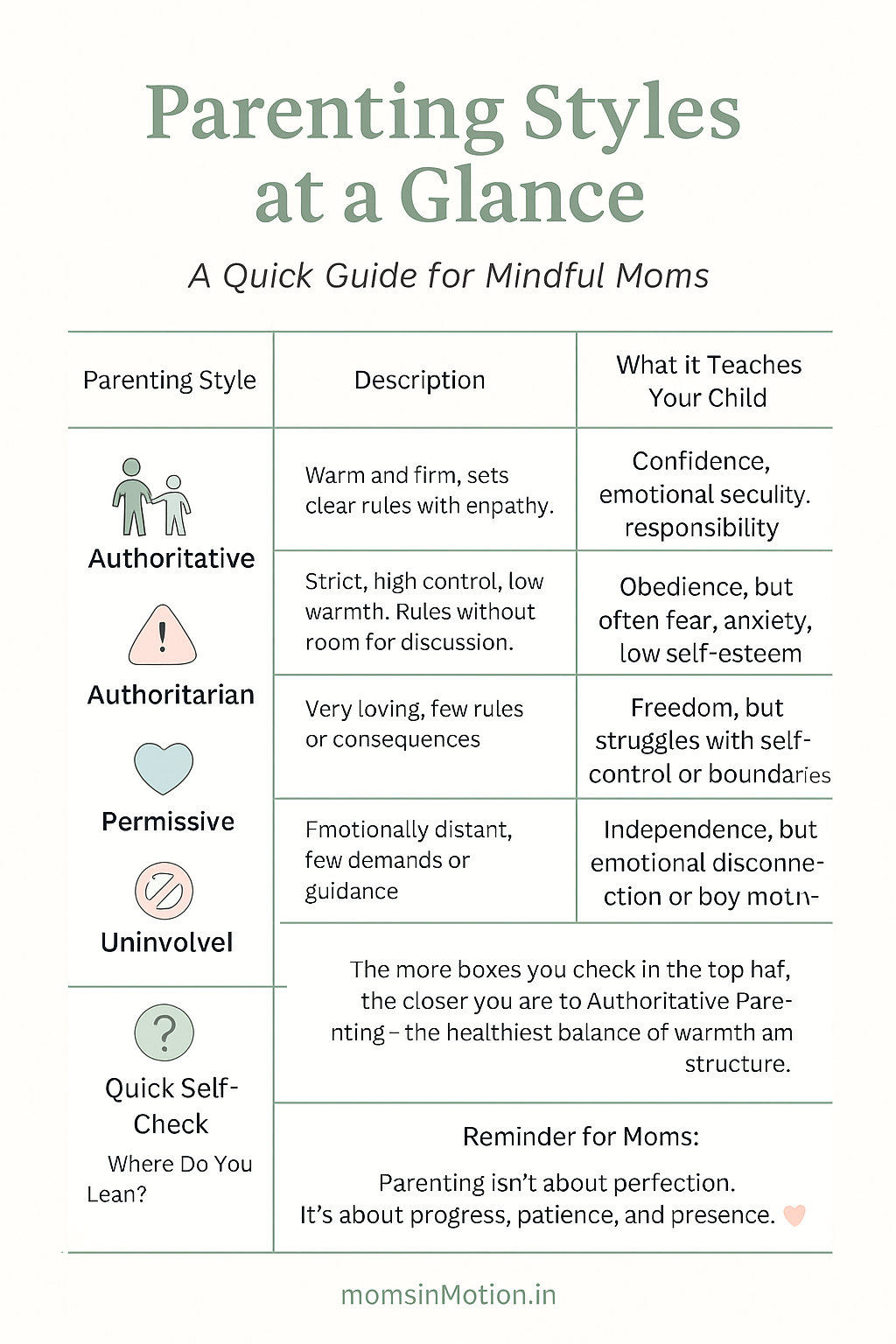
Pop it on your fridge as a daily reminder of the parenting values you want to grow into.
Leave a Reply